Show Me Results Only — Results-Only Audit
Business reviewed: Show Me Results Only • Simpsonville / Greenville / Upstate SC • https://showmeresultsonly.com/
Fourth pass on our own website. The two findings that led the last three reports are closed: a real card has been through the live checkout, and the confirmation email sends. Score moves from 80 to 82.
1. How to use this guide
Executive summary
The short version of what works and what is leaking.
Priority list
Work top to bottom. Priority 1 is first for a reason.
Area sections
Each explains the score, why it matters, and what to change.
2. Executive summary
This is the fourth audit of Show Me Results Only, and the first where the two oldest findings are closed. A real card has been put through the live checkout and the charge arrived. The confirmation email the site describes is now actually sent. Both had been open since the second pass on August 7, and the second one had been open in a different form since the first. Quote path moves from 70 to 88 and the overall score from 80 to 82.
The checkout matters more than the number suggests. Earlier in this project the site ran a test-mode payment link for weeks and nobody noticed, because an untested checkout produces no symptom at all until a customer complains. It is now verified twice over: the owner put a personal card through it, and the endpoint was confirmed independently to create live Stripe sessions rather than test ones.
Fixing the email surfaced a second problem that had been invisible. The intake success page was hardcoded as the paid confirmation, so anyone submitting the free form was told they had submitted a paid audit and promised a report within 5 to 7 business days. A free enquirer was being promised the paid deliverable. That page now adapts to the flow the visitor actually used.
Accessibility remains at 82 and is capped there deliberately. Every finding in that area came from a scanner, and automated tooling catches roughly a third of real WCAG issues. The skip link has been confirmed working by hand, but nobody has completed a purchase using only a keyboard. Until somebody does, claiming more than 82 would be claiming more than was measured.
The structural weakness is now the only significant one left, and it cannot be fixed by editing the website. There are still zero reviews, no testimonials and no published client outcomes. Social proof scores 45 and holds down trust and local discovery alongside it. Four audits have been delivered to real businesses. None of those four has been asked for a review.
One transaction is not a track record. The payment path is proven to work; it is not yet proven to be reliable, and no conversion number on this site means anything until there is enough traffic to trend.
3. What is already working
AI systems can now read the site, and most local competitors cannot say that
All eight crawlers tested return 200: ClaudeBot, GPTBot, OAI-SearchBot, PerplexityBot, Google-Extended, Googlebot, Bingbot and Applebot. A month ago four of those were being refused at the edge.
The scoring method is published in full
Every weight, band and check is on a public page. A buyer can verify the arithmetic on their own report. No competitor checked does this.
A complete sample report is readable before purchase
The previous audit is public in full, including the areas that scored badly. This is the strongest asset on the site and it costs nothing to maintain.
The offer stack is genuinely buyer-sortable
Three named monthly plans with fixed prices, printed exclusions, priced add-ons, and a table mapping each plan to the audit areas it covers.
Lead source is captured per lead, not just in aggregate
Referrer and any utm_ parameters are recorded on first landing and written into the intake record. Most small businesses cannot say where an individual inquiry came from.
The site is fast
323ms server response, 73KB homepage, 100 percent of Core Web Vitals samples in the Good band for Largest Contentful Paint.
4. Priority list
Ask the four delivered clients for a Google review
Why it matters: This is now the largest constraint on the score by a wide margin and the only one the website cannot influence. Social proof sits at 45 and drags trust and local discovery with it. Every other claim on the site is self-issued. It also has the longest lead time of anything left, so starting it late costs the most.
First move: Email the four clients this week using the template in audit-system/delivery-email.md. Send the review request on its own, about a week after delivery, never attached to the report. Three replies would move the overall score more than any further website work.
Complete a purchase using only a keyboard
Why it matters: Accessibility is capped at 82 because everything reported came from a scanner, and scanners find roughly a third of real problems. This matters commercially as well as ethically: the business now sells this exact check, and every client report has to say the check was run by machine.
First move: Unplug the mouse. Tab from the homepage through pricing, into checkout, and through the intake form. Note anywhere the focus outline disappears or Tab gets stuck. Then add the step to the audit process so client reports can say it was performed by hand.
Watch the next two payments as closely as the first
Why it matters: One successful transaction proves the wiring. It does not prove the wiring holds. The failure mode here is silent, which is exactly how the test-mode payment link survived for weeks.
First move: For the next two real payments, confirm three things by hand: the charge in Stripe, the intake record created, and the confirmation email delivered.
Publish something nobody has to take on trust
Why it matters: With the mechanics finished, the remaining gap is evidence. Four audits have been delivered and nothing about any of them is public. A single before-and-after with a named business would do more than another page of copy.
First move: Ask one of the four clients for permission to publish their score, what was found and what changed. Offer to anonymize the business if they prefer.
Keep the two greens on the right backgrounds
Why it matters: The brand carries two greens: #15803D for light backgrounds and button fills, and #16A34A for text on the navy sections. Nothing in the build enforces the split, so the wrong one can be used and nothing will look broken.
First move: When adding a green element, check what sits behind it, and re-run an accessibility scan before publishing any redesign.
5. Score overview
Overall: 82/100 — Strong
Everything that could be fixed by working on the website has now been fixed. What is left is the part no amount of editing reaches: nobody outside this business has said anything about it in public. Zero reviews, zero testimonials, one transaction. The site argues its case well and every claim on it is still self-issued.
Twelve areas, each scored 0–100 and combined using fixed published weights. The full rubric is at showmeresultsonly.com/methodology.html
The shape of the business
Every area at once, against a typical local business.
Where fixing actually pays
Weight against how far below “Strong” each area sits.
Numbers in brackets are the points the overall score would gain if that area reached “Strong”.
6. Homepage conversion
How well the first screen moves a stranger toward the right next step.
What is working
- Opens on the buyer's problem rather than the service description
- A recognition section quotes six things owners actually say, including having been burned by an agency
- Three-step process and a full sample report both above the midpoint of the page
- 323ms response and 73KB total, so nothing is lost to load time
- Single H1, correct viewport, all three images carrying alt text
What to fix
- No form anywhere on the homepage, so every inquiry requires a click-through first
- The proof on the page is still all self-issued, with no third-party voice
- Twelve scored areas plus three plans plus an FAQ is a long page for a first-time visitor on a phone
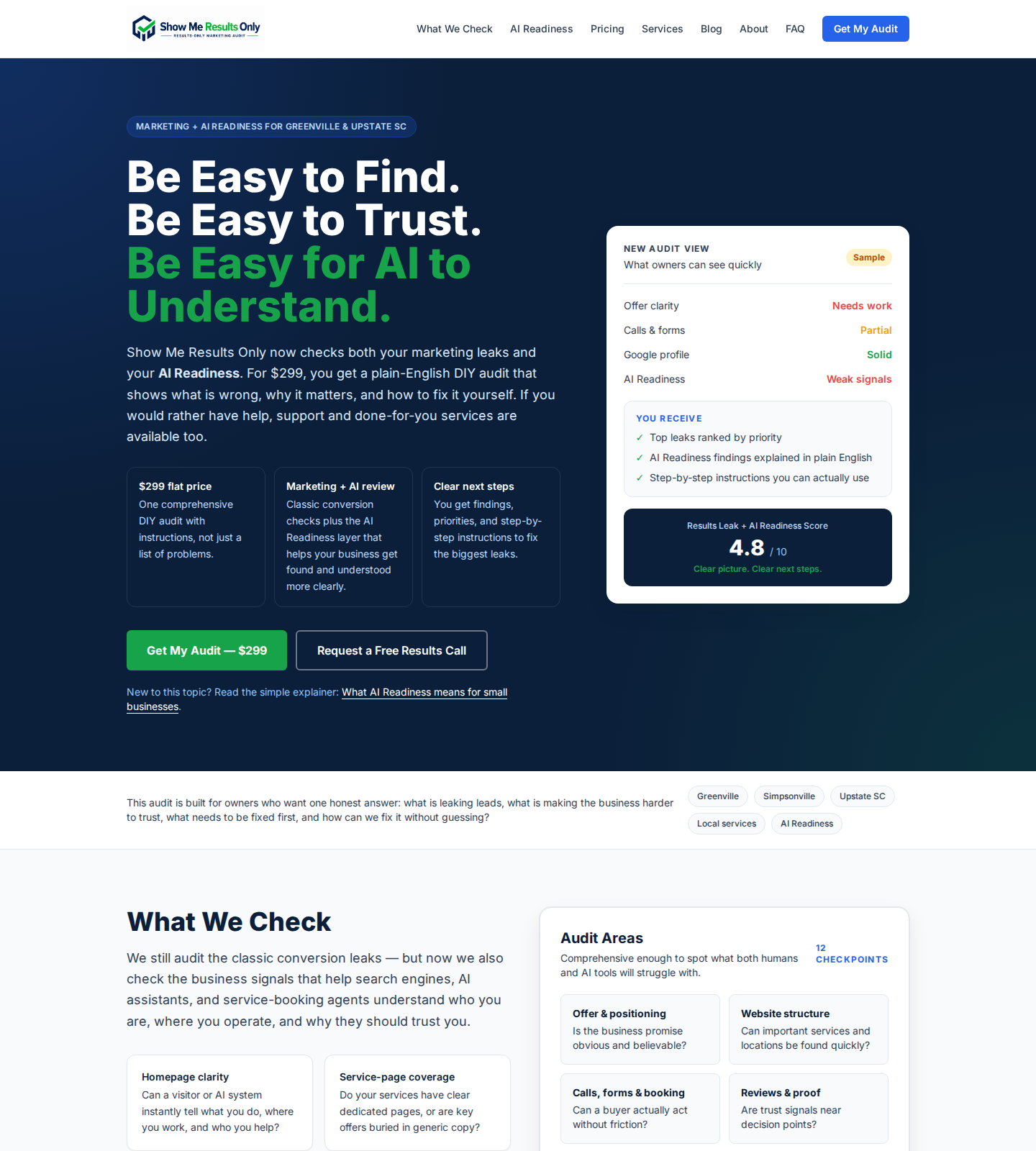
Homepage as it stands. The problem statement leads, the deliverable sits in the right-hand card, and the sample report is one click away.
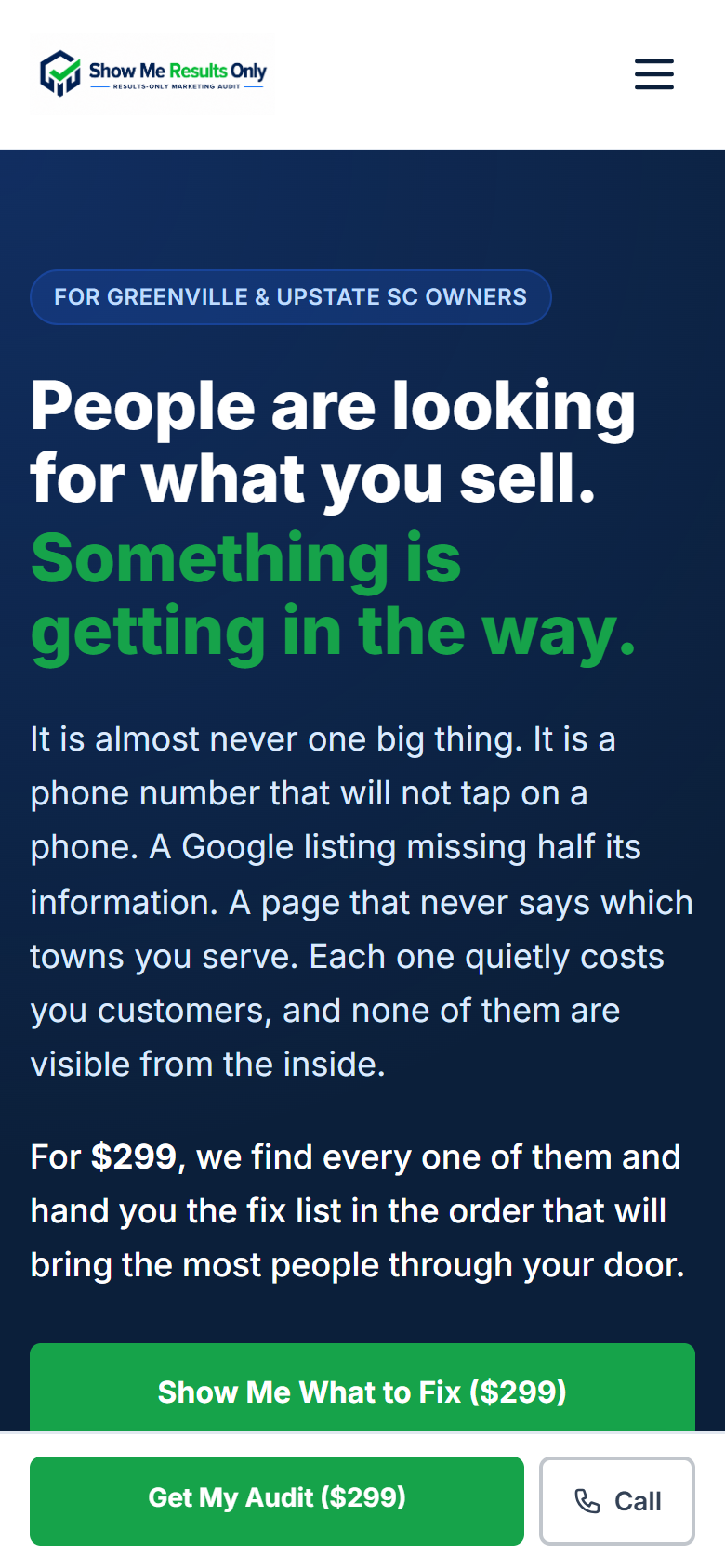
Mobile view with the sticky bar carrying both the buy action and a tap-to-call button.
7. Quote path & lead capture
How easily somebody can buy the audit or raise a hand, and what happens after they do.
What is working
- A real card has been put through the live checkout and the charge arrived. Until August 8 nobody had ever watched money move, and this project had already shipped a test-mode payment link once without noticing
- The checkout creates a live Stripe session, confirmed independently by the session prefix rather than taken on trust
- The confirmation email is sent and delivered. Resend is verified on a sending subdomain, which leaves the existing inbox untouched
- The success page now tells the truth about which flow was used. It previously told a free enquirer they had submitted a paid intake and promised them a 5 to 7 day report
- The inquiry form is on-site, replacing the external Google Form that leaked trust in the first audit
- Response time is stated publicly as one business day rather than left implied
- A two-field capture sits on the homepage, so a decided visitor does not have to navigate first
- Submissions are stored automatically rather than landing in an inbox that can be missed
What to fix
- The paid intake form carries 20 visible fields with 8 required. That is defensible after payment, when the buyer is already committed, but it is worth watching for drop-off
- Only one live transaction has ever run. One is enough to prove the path works and not enough to know it is reliable
- A bad product identifier posted directly to the checkout endpoint returns a 500 rather than a 400. Not reachable through normal use, and cosmetic
8. Trust & review leverage
How strongly proof, examples and confidence cues close doubt at the point of decision.
What is working
- A complete audit is published for anyone to read before buying, including its low scores
- The scoring rubric is public, so a client can check the arithmetic on their own report
- Weights are fixed and stated as never adjusted per client
- A named owner, a working phone number and a stated refund position
- No guarantee of leads or revenue is offered anywhere, which is rarer than it should be
What to fix
- Zero Google reviews
- No testimonials, quotes or named clients anywhere on the site
- No published outcomes from the four audits already delivered
- Every claim on the site is still self-issued
9. Brand clarity
How quickly a stranger understands the offer, the audience and the promise.
What is working
- The headline names the buyer's problem, not the seller's product
- Simpsonville, Greenville and the Upstate are stated in words rather than implied
- The owner is named on every page with a phone number and an email
- The ten audit areas are written in owner language, each led by something a real owner would say
What to fix
- Title tag is 93 characters and truncates in search at around 60
- Meta description is 237 characters and truncates at around 160
- The word 'audit' is doing a lot of work for buyers who may not think of their problem that way
10. Local discovery & GBP
How strong the business looks in local search, maps and service-area relevance.
What is working
- Google Business Profile is live and Google holds a Knowledge Graph entity for the business
- The profile is referenced from the site schema via sameAs plus the Knowledge Graph identifier
- Name, address and phone match exactly between the site and the listing
- Seven Upstate cities named in areaServed schema
- A visible link to the profile in the footer of every public page
What to fix
- Zero reviews on the listing
- No photos and no posts
- Too new to rank for anything competitive
- Not yet appearing in third-party search results for the business name
11. AI Readiness & GEO
How completely modern search and AI systems can reach, parse and describe the business.
What is working
- All eight crawlers tested return 200, including ClaudeBot, GPTBot, OAI-SearchBot and PerplexityBot
- The Cloudflare managed robots.txt block that was disallowing AI crawlers is gone
- Four schema types on the homepage with zero invalid blocks: ProfessionalService, WebSite, HowTo and FAQPage
- llms.txt publishes the full weighting table, what AI readiness tests, and explicit limitations
- Every core page has a Markdown twin served on Accept: text/markdown, roughly 80 percent smaller than the HTML
- Missing URLs now return a real 404 instead of 200 with the homepage
What to fix
- Nothing outside the site references the business, so there is no corroboration for an assistant to draw on
- A search for the business name returns no result in third-party indexes yet
- Content depth is still one explainer article plus the methodology page
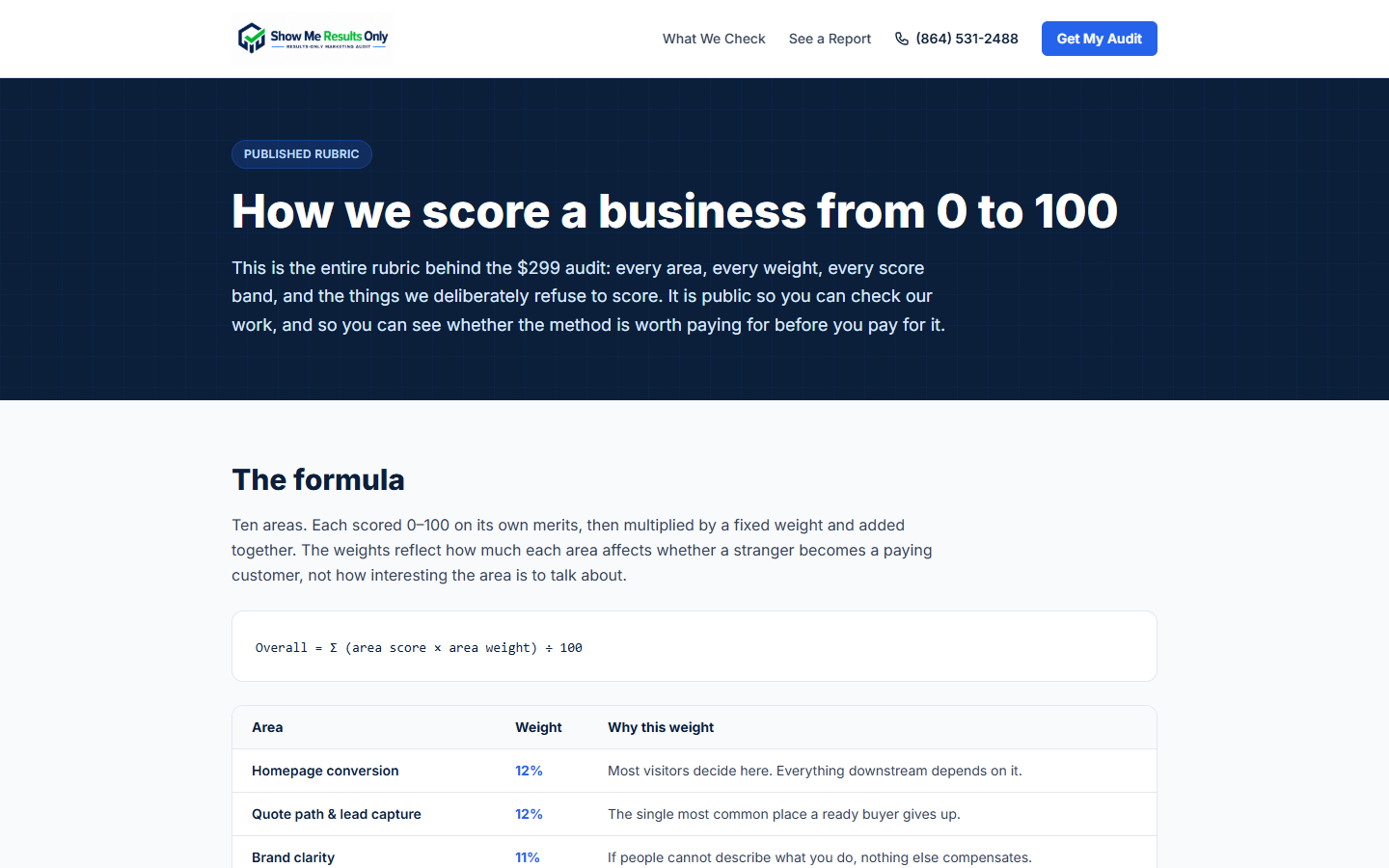
The published scoring rubric. This page is both the trust asset and the most quotable content on the site for an AI assistant.
12. Service packaging
How clearly the site turns capability into something a buyer can choose and price.
What is working
- Three named plans at $297, $597 and $997 with setup fees stated up front
- Every plan prints what is not included directly beside what is
- A table maps all twelve audit areas to which plan watches versus improves each one
- Add-ons are priced and deliberately kept outside the plans
- Commercial terms are on the page: audit first, 90 days then monthly, stated change allowances, one location means one location
What to fix
- The one-time fix sprint has no price or range, so the middle of the ladder is invisible
- "Most popular" appears on Results Capture, which is a forward-looking claim rather than a fact
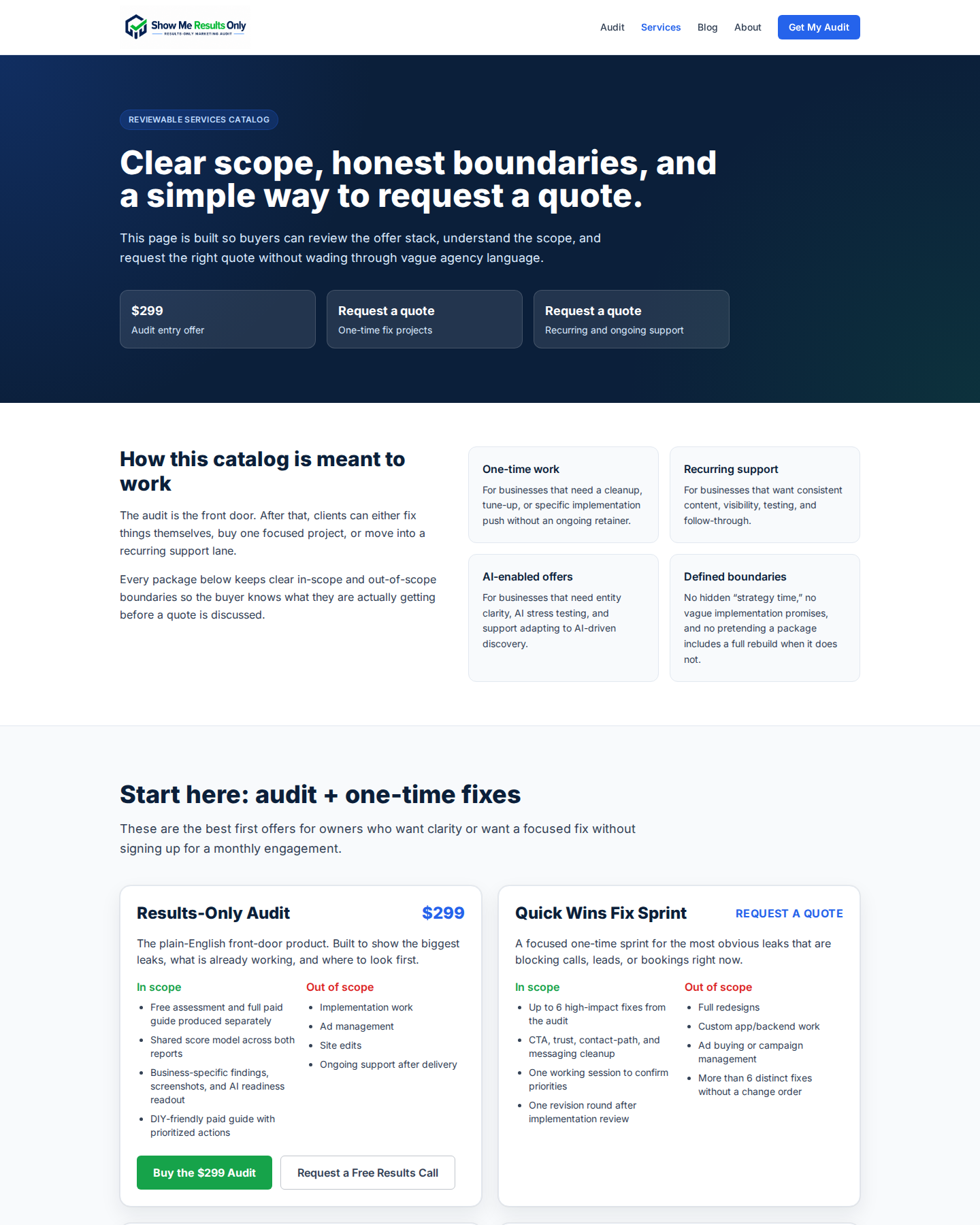
Three plans with prices, exclusions printed beside inclusions, and a table mapping each plan to the audit areas it covers.
13. Mobile & contact path
How easily a phone visitor understands the offer and reaches a human.
What is working
- (864) 531-2488 is a tap-to-call link on every page
- The mobile sticky bar carries both the buy action and a Call button
- The phone number is in the ProfessionalService schema and in contactPoint
- Correct viewport, no horizontal overflow at 390px, business hours published
What to fix
- No text-message option, which many contractors prefer over a call
- No booking or calendar link, so scheduling still requires a back-and-forth
14. Accessibility & ADA risk
Whether someone using a screen reader, a keyboard, or simply needing larger text can use this site, checked against WCAG 2.1 Level AA.
What is working
- Zero WCAG 2.1 AA violations across all seven pages tested with axe-core, down from 42
- Every structural check passes: lang attribute, alt text on all images, programmatic labels on all form fields, one H1 per page, no skipped heading levels
- A skip-to-content link is now the first focusable element on every page, closing a Level A bypass-blocks failure
- Pinch-zoom is not disabled, which is a common and serious failure elsewhere
- No positive tabindex, so keyboard order follows the visual order
- Text over the navy gradient sections was checked by sampling rendered pixels rather than assumed, with the tightest margin measuring 5.01:1 against a 4.5 requirement
What to fix
- Keyboard operability and focus visibility have still not been tested by a human. Automated tooling finds roughly a third of WCAG issues, so a clean scan is not a pass
- Screen reader announcement order has not been checked with an actual screen reader
- The brand now carries two greens and there is nothing in the build to stop the wrong one being used on the wrong background in future
15. Measurement & follow-up
How visible tracking, response discipline and follow-up are from the public surface.
What is working
- Cloudflare Web Analytics collecting traffic and Core Web Vitals with no script of our own
- GA4 tracking begin_checkout, generate_lead, contact_click, view_plan, view_sample_report and scroll depth
- Referrer and utm parameters captured on first landing and written into every intake record
- A one-business-day response promise published beside every contact path
- Intake submissions stored automatically rather than depending on an inbox
What to fix
- No tracking of what happens after an intake arrives, so time-to-first-reply is still not measured
- Conversion events are live but there is not yet enough traffic for the numbers to mean anything
- One transaction is not a conversion rate. Nothing here can be trended until volume exists
16. Social proof & engagement
How much public presence outside the website makes the business look chosen and real.
What is working
- A LinkedIn company page exists
- No abandoned or half-finished profiles creating a bad impression, which is its own kind of tidy
What to fix
- No posting history or engagement anywhere
- No verified presence on any other platform
- Nothing outside the site corroborates that the business exists or that anyone has bought from it
- The LinkedIn page is not yet referenced from the site schema
17. Content exposure & gating
Whether the things that are supposed to be private actually are, checked by requesting them as a stranger with no credentials.
What is working
- None of the 14 standard exposure paths returns anything readable
- The client area returns 401 without credentials, including the report images inside it
- Paid guides are locked by pattern as well as by folder, so one filed in the wrong place stays protected
- Build scripts, the probe, the rubric source and the project notes all return 404
- robots.txt keeps client deliverables out of the index without relying on robots for access control
What to fix
- This scored roughly 25 the day before. Every paid client report sat in a public folder beside the free version that gets emailed out, and one free report linked to the paid guide with a button
- The report builders were readable at their URLs, and each contains the full text of a paid report in source form, so moving the HTML would not have been enough on its own
- Nothing had been checked, which is the actual finding. The exposure was a year old in principle and was found by looking rather than by anything failing
18. Evidence exhibits
Homepage: leads with the buyer's problem, carries the deliverable breakdown and links a full sample report before any purchase.
Services: three priced plans with exclusions printed beside inclusions and a mapping table back to the audit areas.
Methodology: the complete rubric published, including the things the audit deliberately refuses to score.
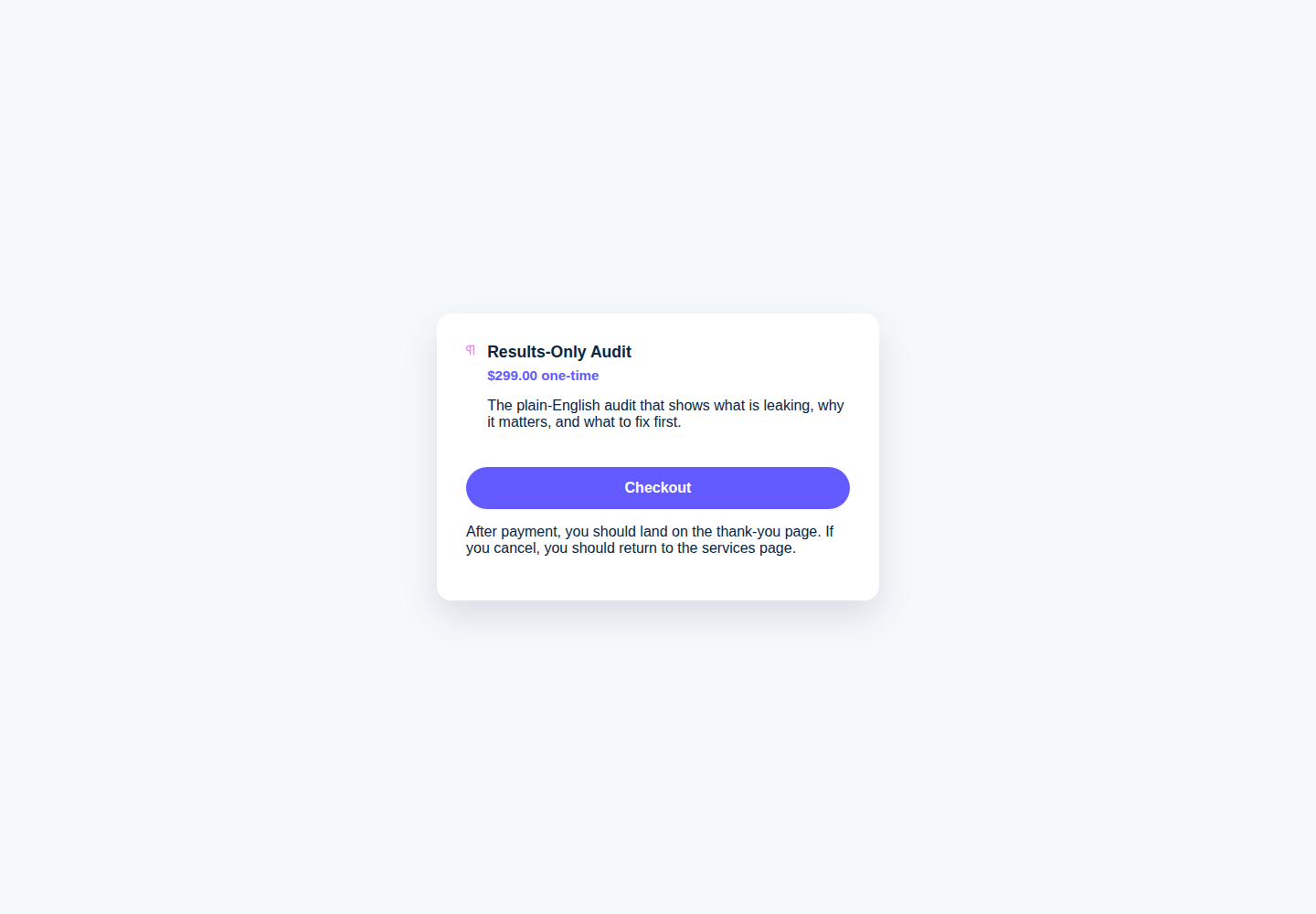
Checkout: rebuilt with what-happens-next and a refund position. The payment behind it remains untested with a real card.
19. Competitor and substitute read
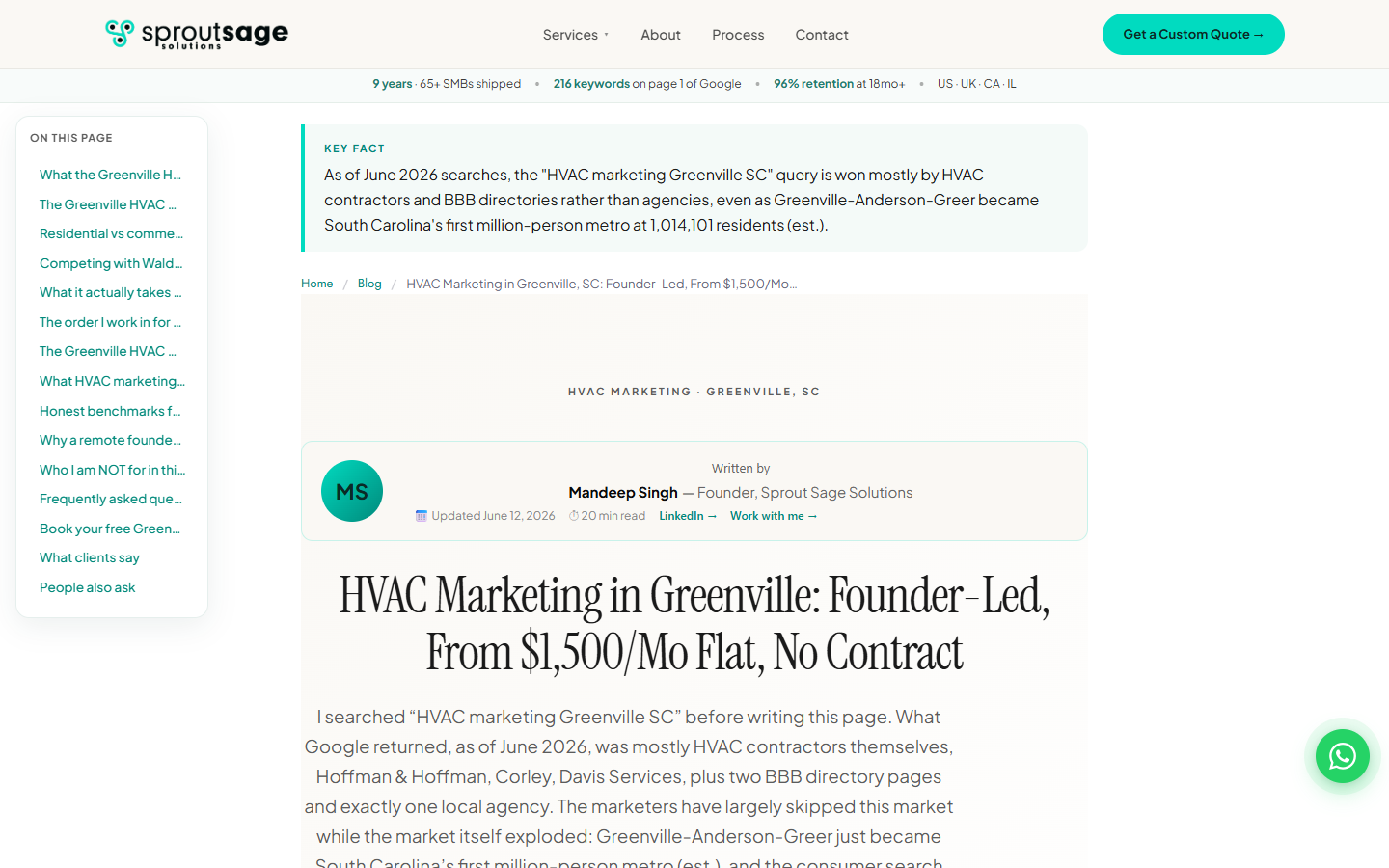
Sprout Sage Solutions: HVAC marketing for Greenville, from $1,500 a month with no contract, and a free audit including a 30-minute session over WhatsApp. This is the closest direct competitor found: same city, same contractor buyer, price stated openly, and the diagnostic given away to open the conversation.
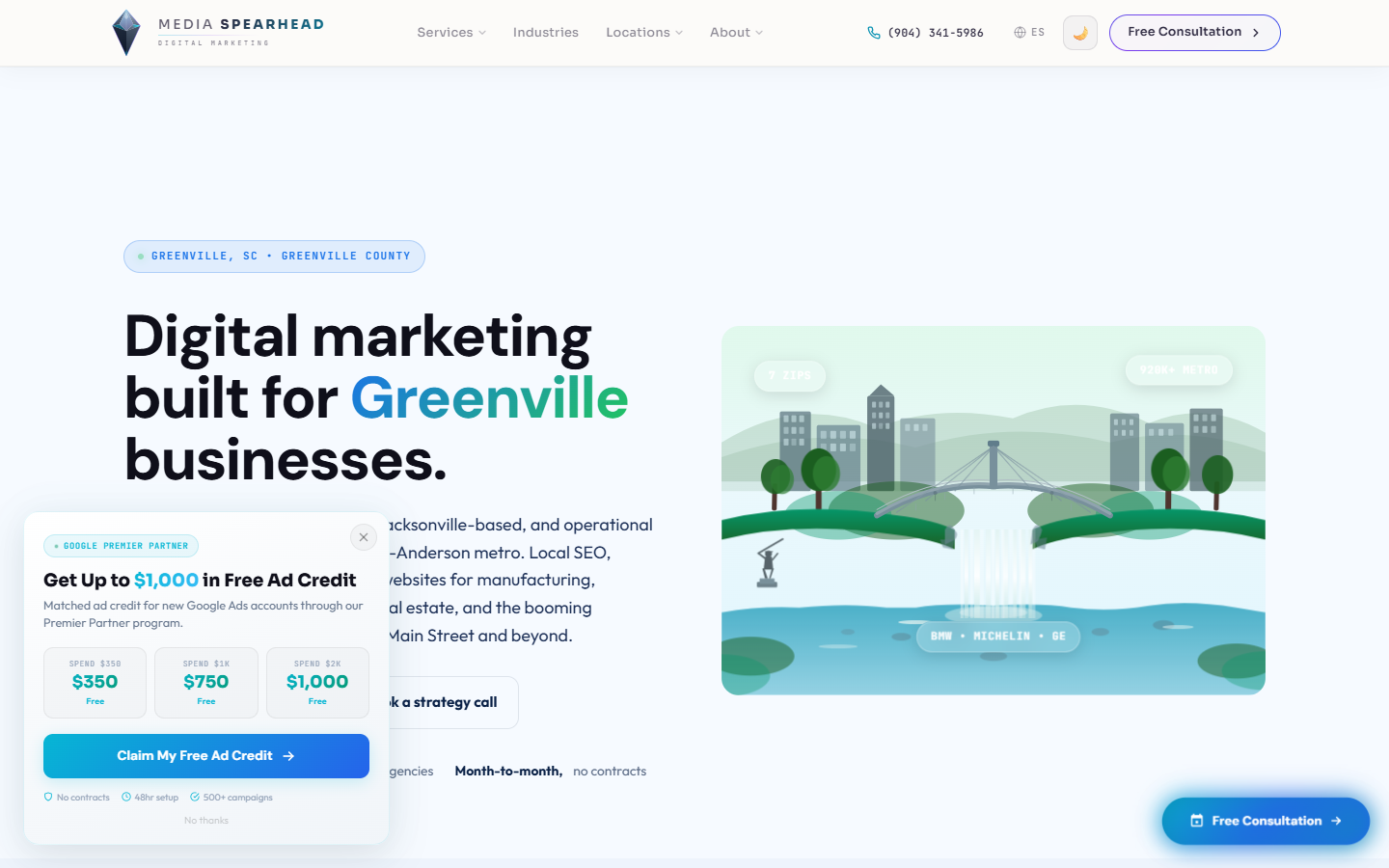
Media Spearhead: Greenville digital agency offering one free audit spanning SEO, Google Ads and the website, positioned as knowing what needs fixing before committing. Bundles services under one team and claims a materially lower blended cost per lead as the reason to consolidate.
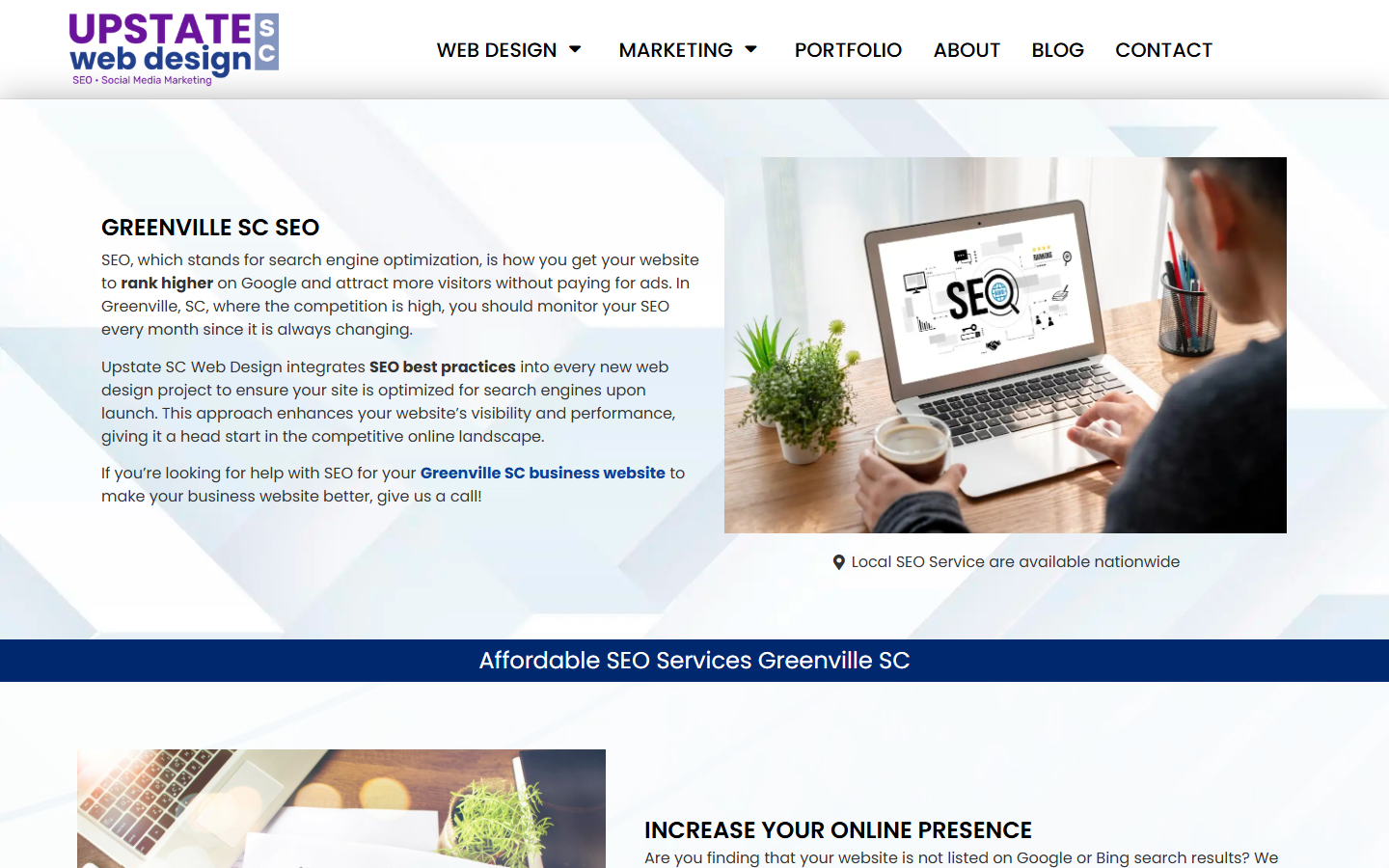
Upstate SC Web Design: Free website and SEO audit for Greenville businesses, competing explicitly on affordability. Thinner on method than the others, but it occupies the same first search result a price-sensitive local buyer will land on.
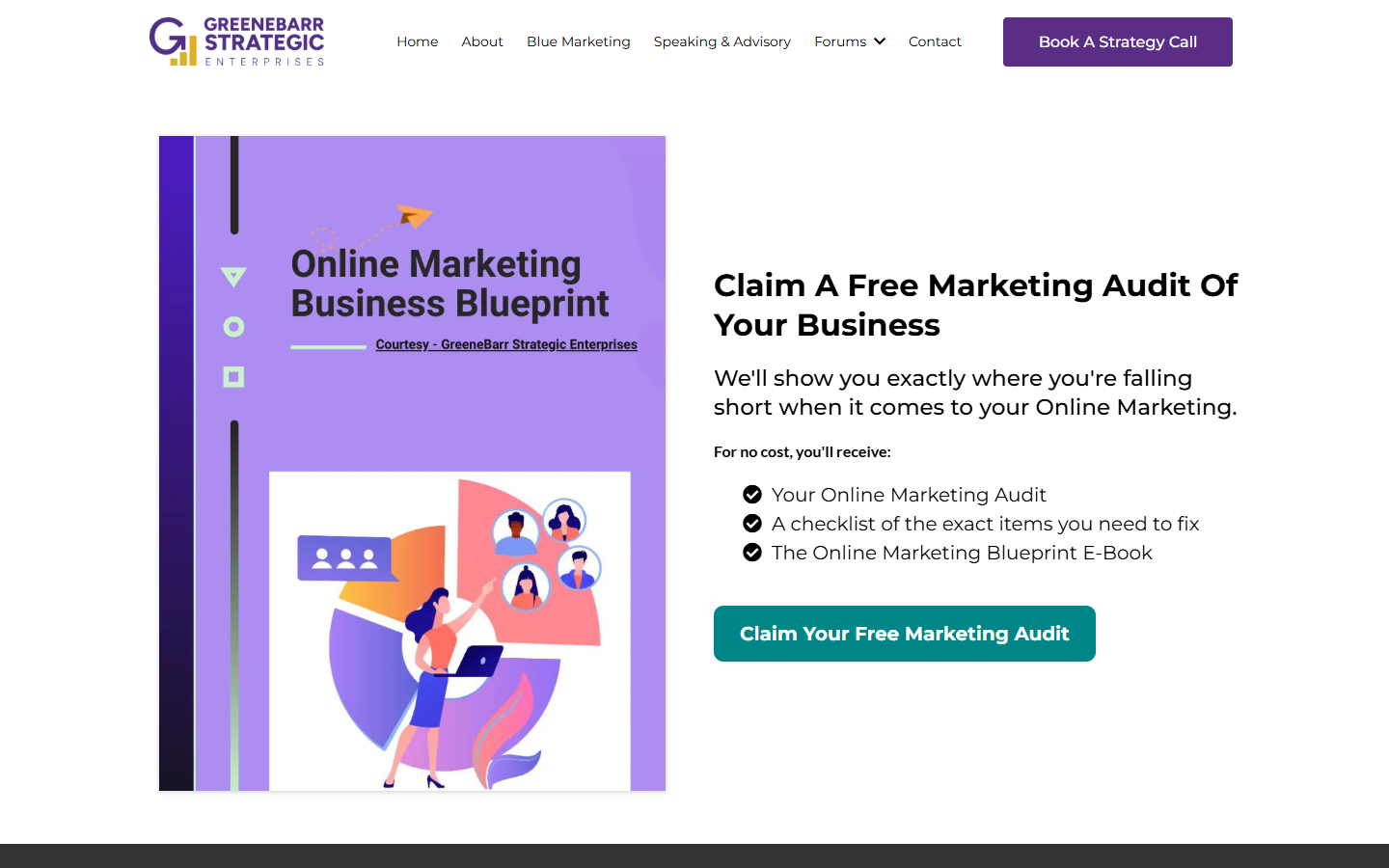
GreeneBarr Strategic Enterprises: Free marketing audit packaged with a custom checklist and a blueprint e-book. The clearest example of the audit used purely as a lead magnet, with the deliverable itself treated as content rather than as the product.
What they do better
- All four give an audit away free. Show Me Results Only charges $299 for one and never explains why on the site.
- Sprout Sage publishes a monthly starting price, so a buyer can self-qualify before making contact.
- Every one of them has been operating long enough to have reviews, history and an established local footprint.
- Several offer an immediate human conversation, by WhatsApp or phone, as the first step rather than a form.
What you can own
- A published scoring rubric. None of the four shows how its audit reaches a conclusion.
- A complete sample report readable before purchase. None of the four will show you one.
- A paid audit carries no obligation. Their free audits exist to sell a retainer, which is a real cost the buyer pays later.
- AI readiness tested rather than claimed, at a moment when none of the four mentions it at all.
- One named person accountable, versus an agency where the buyer does not know who does the work.
20. Off-site footprint
Confirmed
- Google Business Profile is live with a Knowledge Graph entity, /g/11zhbn90r7
- Name, address and phone are consistent between the site and the listing
- A LinkedIn company page exists
- Owner identity and Simpsonville location are stated openly on every page
Not confirmed in accessible checks
- Any review on any platform
- Any social engagement, posting rhythm or follower base
- Any third-party mention, citation or directory listing
- Any search result for the business name in third-party indexes
“Not confirmed” means a public check could not verify it — not that it does not exist. Where a login blocked the check, that is stated rather than guessed.
21. Copy you can paste
Answering the free-audit objection
Try: Most audits around here are free because they are advertising. The free one tells you enough to worry you and not enough to act. This one costs $299, takes 5 to 7 business days, scores you against a rubric you can read before you buy, and comes with no obligation to hire anyone afterwards. Plenty of people buy it, fix the list themselves, and never speak to me again. That is a fine outcome.
Homepage title, under 60 characters
Try: $299 Marketing Audit | Greenville & Upstate SC
Meta description, under 160 characters
Try: We score your business 0-100 across twelve areas and tell you exactly what to fix first. Plain English, 5-7 days, no retainer.
The confirmation email that should exist
Try: Your intake is in. Here is what you sent me, and here is what happens next: I start work today, and your report lands within 5 to 7 business days at this address. Nothing else is needed from you. If anything changes, reply to this email or call (864) 531-2488.
Inline homepage capture
Try: Not ready to buy? Tell me your website and I will tell you the single biggest thing costing you customers. No charge, one business day, no sales call attached.
22. 30 / 60 / 90-day roadmap
Stop the two things that can lose a customer silently
- Send the confirmation email, or remove the promise from all three pages
- Put a real card through the checkout and confirm the money lands
- Email the four delivered clients asking for a review
- Rewrite the homepage title and meta description to fit search
Get outside evidence on the board
- First five Google reviews live
- Ten photos and four posts on the Business Profile
- Add the free-audit objection block to the homepage
- Add an inline capture form near the pricing card
- Publish the LinkedIn page properly and add it to the site schema
Turn delivered work into visible proof
- Two client case studies published with permission
- Price the one-time fix sprint so the middle of the ladder exists
- Three more articles in the AI readiness cluster
- Track time-to-first-reply on every inquiry and publish the actual number
- Re-run this audit and compare against 81
23. If you want this handled for you
Fix the intake receipt
Add an email send to the intake worker so every submission gets a receipt with the delivery window, and record the timestamp so response time becomes measurable rather than merely promised.
Best when: Immediately. This is a broken promise to paying customers, not an optimization.
Proof sprint
Collect reviews and testimonials from the four delivered audits, write two case studies with permission, and place them next to the pricing card and the checkout.
Best when: The website has run out of ways to argue for itself and needs other people to do it.
Local visibility build-out
Business Profile photos, weekly posts, review capture, citation basics, and a LinkedIn presence that actually publishes.
Best when: The listing exists but is empty, which is exactly where this business is now.
Questions about anything in here?
Reply to the delivery email or write to [email protected]. If you disagree with a score, say so — several findings in past audits changed once the owner explained something that was not visible from outside.